Summary: Agentic AI in claims can only work as well as the data it receives. Most commercial auto FNOLs arrive with 40-60% of required fields populated, built from phone calls and free-text descriptions. That is not enough for an AI agent to make autonomous decisions. One insurer that switched to structured, telematics-enriched intake hit 85% completion rates. The sequence is important: structured data first, then agentic AI.
The P&C insurance industry is deep into its agentic AI moment. Carriers are piloting AI claims tools, deploying AI-powered FNOL intake, and building agent-based workflows that promise to handle routine claims without human intervention. The potential is real, but there is a precondition that most of the conversation around agentic AI overlooks: the quality of the data that feeds the agents.
An AI agent is a system that takes in information, reasons about it, and takes action. The sophistication of the reasoning and the quality of the action both depend entirely on the quality of the input.
In claims, the input is the first notice of loss. And for commercial auto, the typical FNOL looks something like this:
This is the raw material that an agentic AI system is expected to work with. And the truth is that no amount of sophisticated reasoning can compensate for incomplete, unstructured, inaccurate input data.
Here’s a straightforward example. An agentic claims system receives an FNOL with the description: “Driver says he was hit by another vehicle at an intersection.” The agent needs to determine liability, estimate severity, check for fraud indicators, and route the claim. But the FNOL does not include the speed at impact, whether the driver braked, the exact GPS coordinates, the time of day, weather conditions, or any corroborating evidence.
The agent can guess. It can use statistical models based on similar claims. It can flag the claim for human review. But it cannot do what it was designed to do, which is handle the claim autonomously, because the input data is not sufficient.
Now consider the same claim with a different input. Instead of a phone call transcription, the FNOL arrives with:
With this input, the agentic AI system can actually do its job. It can assess liability with confidence (dashcam confirms the other party ran a red). It can estimate severity based on impact speed and G-force data. It can check the driver’s report against the telematics data for consistency (fraud indicator: does the driver’s account match the machine data?). It can route the claim appropriately and, for a straightforward case like this, potentially straight through process the claim without human intervention.
The difference between these two scenarios is not the sophistication of the AI. The same model, the same reasoning capability, the same agent architecture. The difference is the input.
One of the less discussed metrics in claims operations is FNOL completion rate: what percentage of first notices arrive with all required data fields populated and verified?
For most carriers handling commercial auto claims through phone-based intake, completion rates hover between 40% and 60%. That means at least 40% of claims arrive with missing information, which triggers follow-up calls, adjuster requests, and delays before any substantive work can begin.
One global insurer that switched from phone-based intake to structured, telematics-enriched incident capture achieved an 85% FNOL completion rate. That 25 to 45 percentage point improvement in data completeness has cascading effects on every downstream process, including any AI system that consumes FNOL data as input.
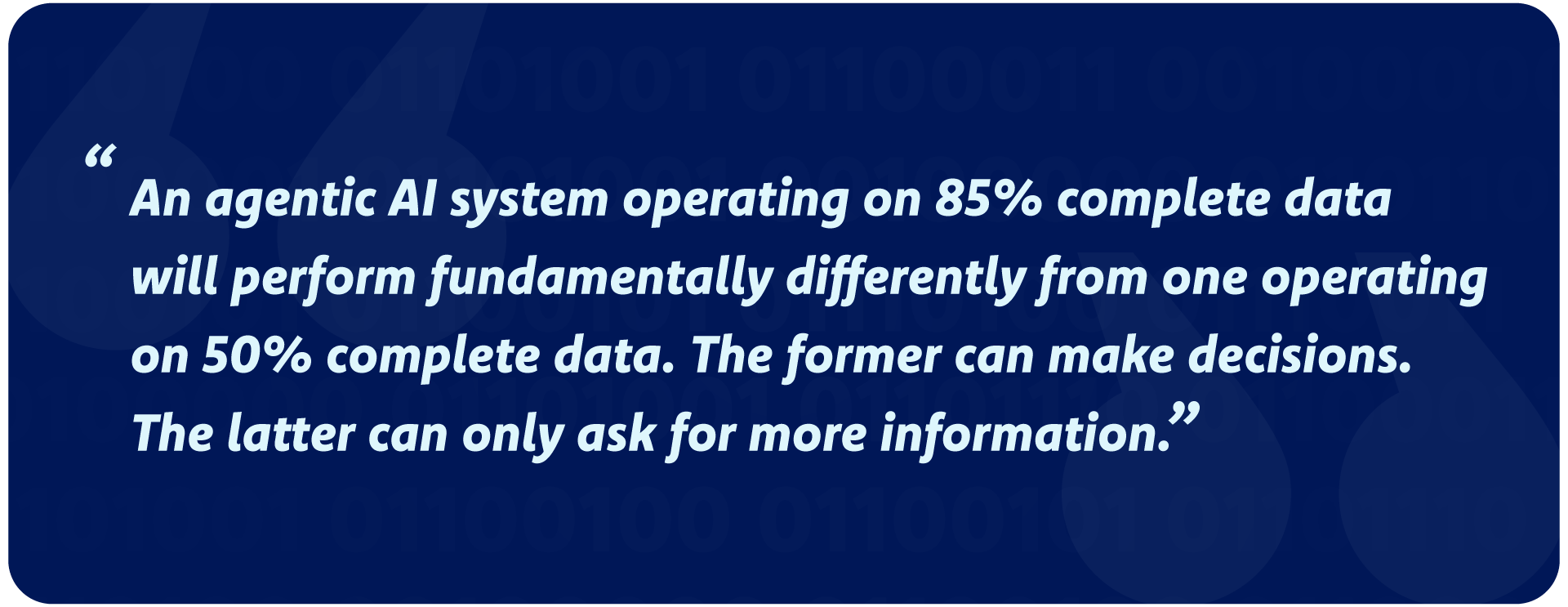
An agentic AI system operating on 85% complete data will perform fundamentally differently from one operating on 50% complete data. The former can make decisions, the latter can only ask for more information.
Structured incident data does not materialize from a single source. It requires assembling telematics data (from 20+ providers, each with different APIs and data schemas), dashcam footage, structured driver reports, and contextual data like weather and road conditions into a single, normalized record.No insurer is going to build and maintain 20 individual telematics integrations. The viable approach is a translation layer that normalizes all of it into a claims-ready format, regardless of which telematics provider the fleet uses.
For carriers running Guidewire ClaimCenter, this matters directly. Guidewire provides the claims management infrastructure. But the data quality of what enters that infrastructure determines how effectively it operates, and how effectively any AI capabilities built on top of it will perform.
The industry conversation around agentic AI in P&C tends to focus on the model: what can the agent do, how does it reason, what decisions can it make autonomously? These are important questions. But they are second-order questions.The first-order question is: what data does the agent have to work with?
Carriers that invest in structured incident data capture before or alongside their AI investments will see those AI systems perform well. Carriers that deploy agentic AI on top of their existing, unstructured intake processes will see those systems struggle with the same data quality problems that their human adjusters have struggled with for decades. The sequence is: structured data first, then agentic AI. Get the input right, and the output follows.